Before spending thousands on solar panels, you want to know one thing: when do I get my money back? It’s a fair question, and one that every homeowner and business owner in Ireland should be asking before signing on the dotted line.
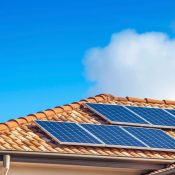
Calculating solar panel ROI in Ireland isn’t complicated once you understand the main variables. For most Irish homes, the payback period sits around five years, while commercial systems typically pay for themselves in four to seven years. After that point, your solar panels are essentially generating free electricity for the next two decades. With residential systems, you can expect to save 60% to 70% on your electricity bills, and with the SEAI grant covering up to €1,800 of your upfront costs, the numbers stack up well for most properties.
But ROI isn’t just one number. It depends on your system size, how much electricity you actually use during daylight hours, your roof orientation, whether you add battery storage, and what rate you’re getting for exporting surplus power back to the grid. Let’s break all of this down so you can work out what solar would actually return for your specific situation.
What Does Solar Panel ROI Actually Mean?
ROI, or return on investment, is simply a measure of how much money you get back compared to what you spent. For solar panels in Ireland, it’s usually expressed in two ways: the payback period (how many years until the system has paid for itself) and the percentage return over the system’s lifetime.
Payback Period vs Lifetime Return
Most people focus on payback period because it’s the easiest to grasp. If you spend €8,000 on a solar system after the SEAI grant and you save €1,600 a year on electricity, your payback period is five years. Simple enough.
Lifetime return is where things get more interesting. Solar panels last 25 years or more, and after your payback period, every euro saved is pure profit. A residential system that saves €1,600 per year over 25 years generates €40,000 in total savings from an initial investment of around €8,000. That’s a return most investment funds would envy.
Why ROI Varies Between Properties
No two homes are the same when it comes to solar returns. A south-facing roof with minimal shading in Meath will outperform a partially shaded east-facing roof in Dublin city centre. Your electricity consumption patterns matter too. If you work from home and use most of your power during the day, you’ll get a better return than someone whose house sits empty until 6pm.
Which Factors Determine Solar ROI in Ireland?
Getting an accurate picture of your solar returns means looking at several variables together. Here are the main ones that affect your bottom line.
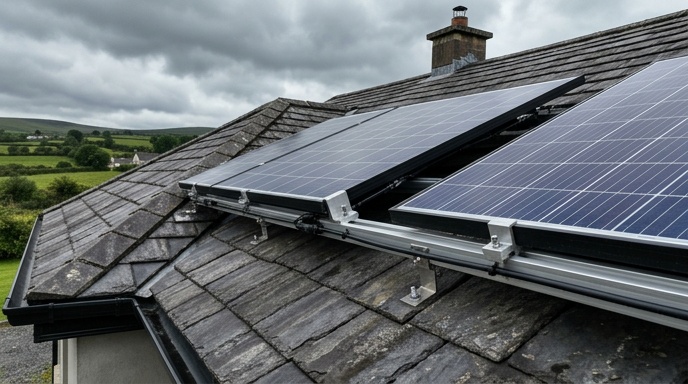
- System cost after grants: For residential, the SEAI grant covers up to €1,800 for systems of 4kWp or more, while 0% VAT on solar installations keeps upfront costs lower than you might expect
- Annual electricity savings: Based on your current usage, electricity rates, and how much solar-generated power you consume directly
- Export income: Surplus electricity sold back to the grid adds to your annual returns, though rates vary between suppliers
- Self-consumption rate: The percentage of solar electricity you use yourself rather than exporting; higher self-consumption means higher savings because you avoid buying at retail rates
- System performance: Panel efficiency, inverter quality, and degradation over time all affect real-world output
- Electricity price trends: If electricity prices rise (as they have done consistently in Ireland), your savings increase year on year
Each of these factors can shift your ROI by a year or more in either direction. That’s why a personalised consultation from an experienced installer is worth more than any online calculator alone, though calculators are a decent starting point for getting ballpark figures.
How Do You Calculate Payback Period Step by Step?
Here’s a straightforward method you can use to estimate your own solar payback period. You don’t need a spreadsheet, though it helps.
Step One: Work Out Net System Cost
Take the total quoted price for your solar system (panels, inverter, mounting, installation, everything). Then subtract the SEAI grant. For a typical 4kWp residential system, you might be looking at around €9,500 before the grant, which drops to roughly €7,700 after the SEAI solar electricity grant of €1,800. Remember, there’s already 0% VAT on solar in Ireland, so no extra VAT savings to factor in.
Step Two: Estimate Annual Savings
A 4kWp system in Ireland produces approximately 3,400 to 3,800 kWh per year, depending on location and orientation. If you consume 70% of that directly (roughly 2,500 kWh) and your electricity rate is around 35 cents per kWh, that’s about €875 saved on bills. Add export payments for the remaining 30% at whatever your supplier offers, and you might reach €1,100 to €1,400 in combined annual savings.
Step Three: Divide and Done
Net cost divided by annual savings gives you the payback period. Using the figures above: €7,700 divided by €1,200 in average annual savings gives a payback of roughly 6.4 years. With higher self-consumption (say, a family working from home), that figure can drop below five years. Adding battery storage shifts the equation again, as it increases self-consumption but also adds to upfront costs.
What ROI Can Businesses Expect From Commercial Solar?
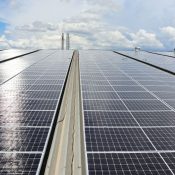
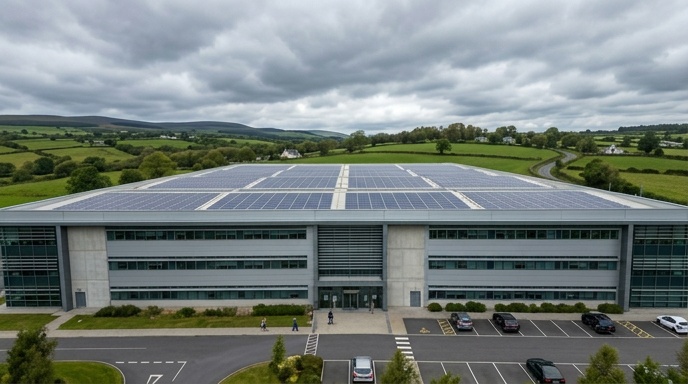
Commercial solar tends to deliver even better returns than residential, for one simple reason: businesses use most of their electricity during daylight hours, exactly when solar panels are producing. That means self-consumption rates of 80% or higher are common for offices, retail units, and warehouses.
A 20kWp commercial system produces around 17,300 kWh annually. At savings of roughly 23 cents per kWh, that translates to approximately €6,000 per year. Larger 50kWp systems can generate around €12,000 annually. Commercial systems typically pay for themselves in four to seven years, delivering an ROI of 14% to 25%, which is significantly better than most business investments.
The non-domestic microgen grant of up to €162,600 makes a serious dent in upfront costs for larger commercial installs, improving payback times even further. Going Solar has completed hundreds of commercial projects across Ireland, the UK, and Europe, so the figures quoted for commercial systems are based on real-world performance rather than theoretical models.
Do Battery Storage Systems Improve ROI?
Battery storage is one of the most debated topics in Irish solar circles. Does it actually improve your return, or does it just add cost?
Without a battery, any solar electricity you don’t use immediately gets exported to the grid. You get paid for this, but at a lower rate than what you’d pay to buy it back later in the evening. A battery lets you store that surplus and use it when the sun goes down, meaning you buy less from the grid overall.
When Batteries Make Financial Sense
Batteries tend to improve ROI when your daytime self-consumption is low. If you’re out of the house all day and only using electricity in mornings and evenings, a battery captures what would otherwise be exported at a low rate and lets you use it at peak times instead. The gap between export rates and retail electricity prices is where the financial benefit sits.
When They Don’t Add Much
If you already have high daytime usage (working from home, running a business from the property), a battery might not add enough savings to justify the extra €3,000 to €5,000 cost. The maths needs to be done on a case-by-case basis. Going Solar offers options from Huawei, Kstar, Puredrive, and FoxESS batteries, so there’s flexibility to match different budgets and energy profiles.
What Hidden Benefits Affect Long-Term Returns?
Pure bill savings and export income don’t tell the full story. Several other financial benefits feed into your overall return on solar.
BER rating improvements are one of the bigger ones. Solar panels can bump your Building Energy Rating by one or two grades, which directly affects property value. Estate agents in Ireland increasingly list BER ratings as a selling point, and buyers are willing to pay more for a home with lower running costs.
Property value increases are harder to put an exact figure on, but research consistently shows that homes with solar sell for more than equivalent homes without. Even conservatively, a €5,000 to €10,000 uplift on a property that cost €8,000 to fit with solar is a strong return on its own.
Then there’s protection against future electricity price rises. Every kWh you generate yourself is a kWh you don’t need to buy, regardless of what happens to energy prices. Given the trajectory of Irish electricity costs over the past decade, this hedge against inflation is worth more than most people realise when they’re doing initial calculations.
Ready to See What Solar Would Return for Your Property?
The numbers in this guide give you a solid framework, but every property is different. Roof type, orientation, shading, daily electricity habits, and whether you add battery storage all shift the final figure. Going Solar has completed over 8,000 residential installations across Ireland and holds ISO 9001 certification, so you’re getting engineering-grade precision rather than guesswork. Get in touch with their team on (01) 485 3738 or use the online solar calculator at goingsolar.ie to get a personalised estimate for your home or business, and they’ll handle everything from system design through to SEAI grant paperwork and installation.