Not every home or business in Ireland has a roof that suits solar. Some roofs face the wrong way, sit in the shade of trees or a neighbouring building, are too small, or are simply too old to drill into. If that sounds like your property, a ground-mounted system can be a better option than forcing panels onto an awkward roof.
Ground-mounted solar puts your panels on a frame in the garden, yard or field instead of on the roof. It gives you full control over the angle and direction, which can mean more electricity from the same number of panels. It also costs a little more to install. This guide explains how ground-mounted systems work, when they make sense in Ireland, what they cost, the planning rules, and the grants you can claim.
What Are Ground Mounted Solar Panels?
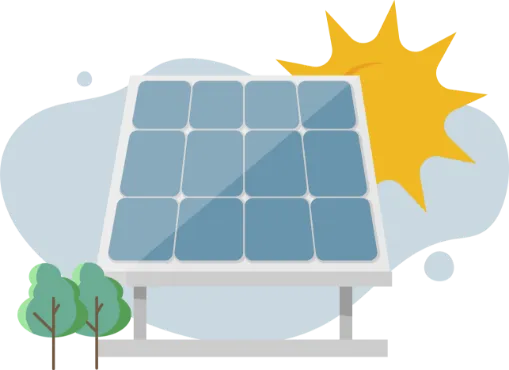
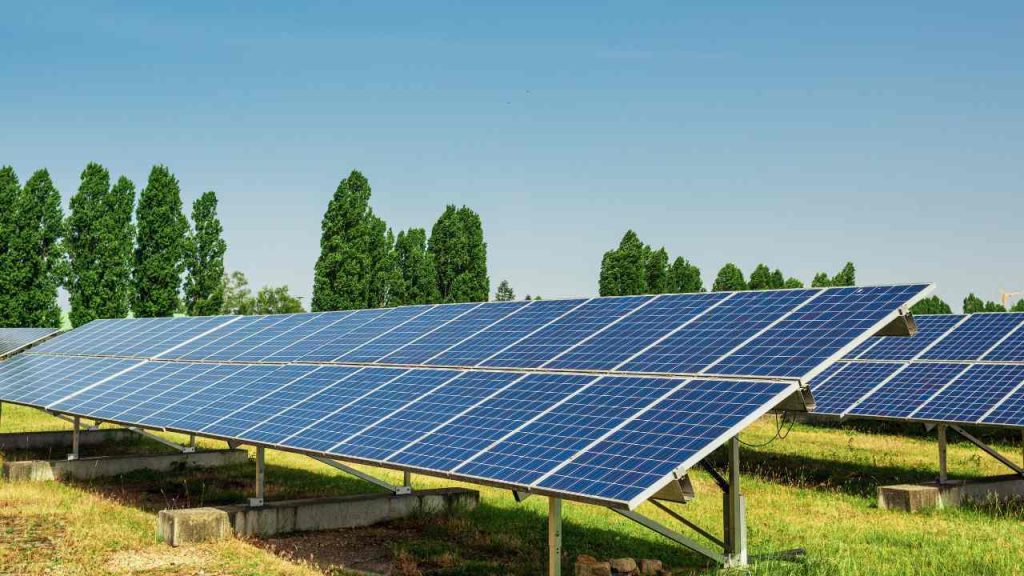
Ground-mounted solar panels are fixed to a freestanding metal frame anchored into the ground rather than bolted to a roof. The frame holds the panels at a set tilt and direction so they catch as much daylight as possible.
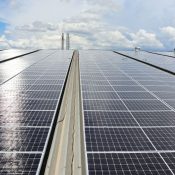
You will most often see large arrays like this on farms and solar sites, but the same idea scales down neatly for homes and businesses. On a domestic property the array usually sits at the rear or side of the house on a short run of foundations, with a cable trench carrying the power back to the inverter and consumer unit.
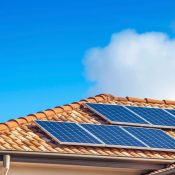
The panels themselves are the same panels used on rooftops. What changes is how they are mounted and how far the electricity has to travel to reach your home.
When a Ground Mounted System Makes Sense
Ground-mounted solar is not the default choice for most Irish homes. A rooftop system is usually cheaper and quicker, so it stays the right call when the roof is sound and reasonably well oriented. A ground mount earns its place when the roof cannot do the job well.
It is worth considering if:
- Your roof faces mainly north, or is heavily shaded by trees, chimneys or nearby buildings.
- Your roof is small, cluttered with vents, or not suited to extra weight.
- You have unused garden, yard or paddock space and want a larger system than the roof can hold.
- You run a farm or business with open land and high daytime electricity use.
- You want panels at ground level for easy cleaning and checks without ladders or scaffolding.
It is probably not the right choice if your garden is small, if the only open space sits in shade, or if the run back to the house is very long. In those cases the extra cabling and groundwork can outweigh the benefit. A site survey is the honest way to tell which side of that line your property falls on.
Are Ground Mounted Panels More Efficient?
This is where a lot of guides overstate things. A solar panel does not become more efficient just because it sits on the ground. An identical panel produces the same power on a roof or on a frame in the same conditions.
What a ground mount gives you is control. On a roof you are stuck with whatever pitch and direction the builder gave you. On the ground you can set the panels to face close to south and tilt them at the angle that works best for Irish daylight, usually around thirty to forty degrees. You can also keep them clear of shade. When your roof is poorly oriented or shaded, that control can lift real-world output noticeably. When your roof is already south-facing and clear, the gain is small.
A few things decide how much a ground array actually produces:
- Direction and tilt. Facing south at a sensible tilt gives the strongest yearly yield, so orientation matters a great deal.
- Shading. Panels sit lower to the ground, so nearby hedges, walls and trees count more than they would on a roof. Open, clear ground is best.
- Cable distance. The further the array is from the inverter, the more you lose in the cable run, so sensible siting matters.
- Mounting and foundations. A solid frame keeps the panels at the right angle through Irish wind and rain for the life of the system.
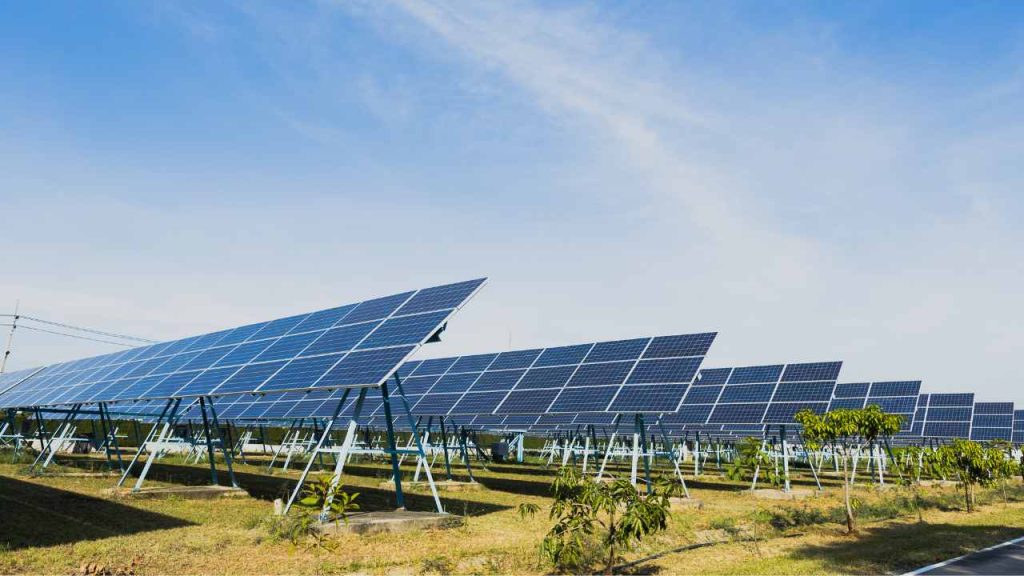
Some large arrays use sun-tracking frames that follow the sun through the day. These can raise output, but they add cost, moving parts and maintenance, so they are rarely worth it on a domestic system.
How Much Space Do You Need?
Ground-mounted panels need more room than a roof array, because each row needs a frame, airflow underneath, and a gap so one row does not shade the next.
A typical home panel is around 1.75 metres by 1.1 metres, close to two square metres each. Ten panels therefore come to roughly nineteen to twenty square metres of panel area, and on the ground you need a little more room again for the frame, airflow and access. The exact footprint depends on how the rows are laid out and how steep the tilt is.
This matters for planning, because the 25 square metre exemption for homes is measured on the panel area, not the ground it covers. Many domestic ground arrays are kept to around twelve panels or fewer so they stay inside that limit and keep the process simple.
How Much Do Ground Mounted Solar Panels Cost in Ireland?
Ground-mounted systems cost more than the same system on a roof. The panels, inverter and grant are the same. The extra cost comes from the mounting frame, the foundations (concrete piers or driven ground screws), and the trench and cabling that carry the power back to the house.
As a rough guide for a home, a standard roof system runs from about €5,000 to €15,000 before the SEAI grant, depending on size and specification. A ground mount typically adds in the region of €1,500 to €2,000 on top of an equivalent roof system, which works out at roughly ten to twenty-five per cent more.
Indicative figures for a home, before the grant:
| System Size | Typical Roof System | Ground Mount, Approx. |
| 4 kWp (about 10 panels) | €6,000 to €9,000 | add €1,500 to €2,000 |
| 6 kWp (about 14 panels) | €8,500 to €11,500 | add €1,500 to €2,000 |
A few points worth knowing:
- 0% VAT applies to home solar supply and installation in Ireland, and it is already built into these figures.
- The SEAI grant of up to €1,800 then comes off the total, and it applies to ground-mounted systems too.
- These are ballpark ranges only. The real price depends on your ground conditions, how far the array sits from the house, and the size of system you need. We confirm your exact figure after a site survey.
Do You Need Planning Permission?
For most homes, a modest ground-mounted array is exempt from planning permission, but the rules are stricter than for roof panels. Under the current regulations a freestanding solar installation at a house is exempt when all of the following apply:
- The total panel area is no more than 25 square metres.
- The array is not placed forward of the front wall of the house, so it sits to the rear or side.
- The height does not exceed 2.5 metres at its highest point above the ground.
- Enough private open space is kept for the occupants, with at least 25 square metres of garden left over.
For non-domestic buildings such as commercial premises and farms, the exempt area is larger, up to 75 square metres.
These exemptions do not apply to protected structures or to homes in an architectural conservation area, and separate limits can apply near airports and other aviation sites. If your array is bigger than the exempt size, or your property falls into one of these categories, you will need to apply to your local authority for permission. We check this for you before any work starts.

Are Ground Mounted Systems Eligible for Grants?
Yes. The mount type does not change your grant eligibility, as long as the system meets the scheme rules.
- Homes. The SEAI Solar PV grant is worth up to €1,800 (€700 per kWp for the first 2 kWp, then €200 per kWp up to 4 kWp). Your home must have been built and occupied before 2021, and the work must be done by an SEAI-registered installer.
- Farms. Farmers can look at the TAMS 3 scheme, which covers a share of the cost of on-farm solar, including ground-mounted arrays sited close to the farmyard. This suits agricultural sites with plenty of open land.
- Businesses and community sites. The Non-Domestic Microgen grant supports larger systems, up to a maximum of €162,600 for the biggest installations.
We handle the full grant application on your behalf, so you are not left filling in forms.
Ready to Look at Ground Mounted Solar?
Ground-mounted solar is a strong option when your roof is not the right home for panels, or when you have land to put to work. It lets you face the panels the right way, and at ground level it is easy to keep clean and checked. It costs a little more than a roof install, so the sensible first step is a proper look at your site.
Going Solar designs and installs ground-mounted and rooftop systems across Dublin and Leinster, and we handle the survey, the design, the grant paperwork and the installation from start to finish. Get in touch for a free consultation and a quote built around your property.