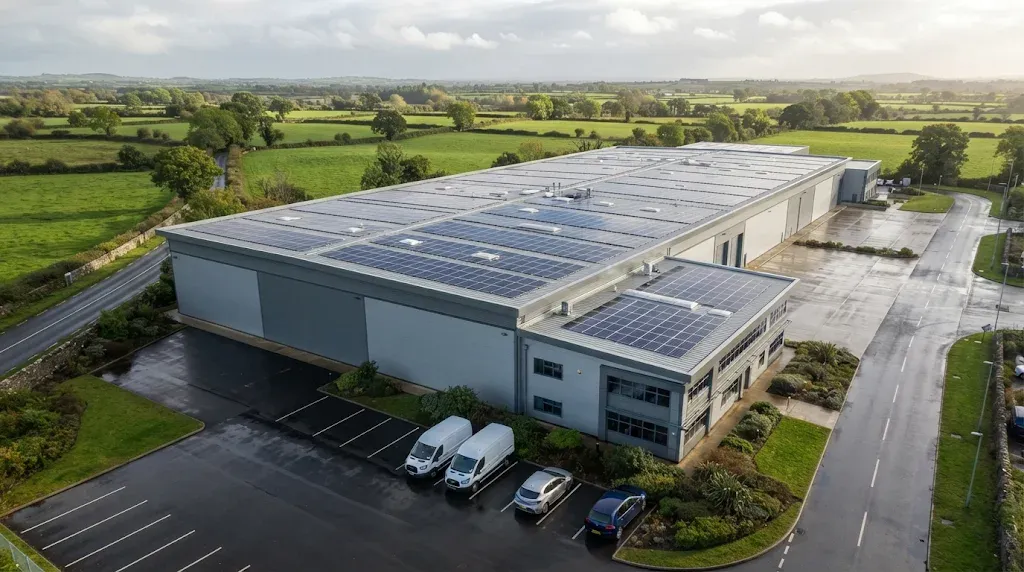

In Ireland, commercial solar panels cost €1,000 to €1,500 per kWp installed, excluding VAT, for rooftop systems between 20kWp and 100kWp. Larger arrays of 200kWp to 500kWp come in at around €850 to €1,050 per kWp. A 50kWp system on a warehouse or factory roof usually lands between €50,000 and €75,000 before grant.
Two supports then cut that figure. The Non-Domestic Microgen Grant currently pays up to 45% of eligible ex-VAT costs, capped at €325,200, and the Accelerated Capital Allowance lets a business write off qualifying equipment against profits in year one.
This guide is written for business owners, facilities managers and finance leads pricing a commercial building. If you’re pricing a house instead, the guide to home solar panel costs covers domestic pricing and grants.
Every figure below is an indicative market range from Irish industry sources as of November 2026, so your own quote will depend on your roof and your usage.
How Much Do Commercial Solar Panels Cost in Ireland 2027?
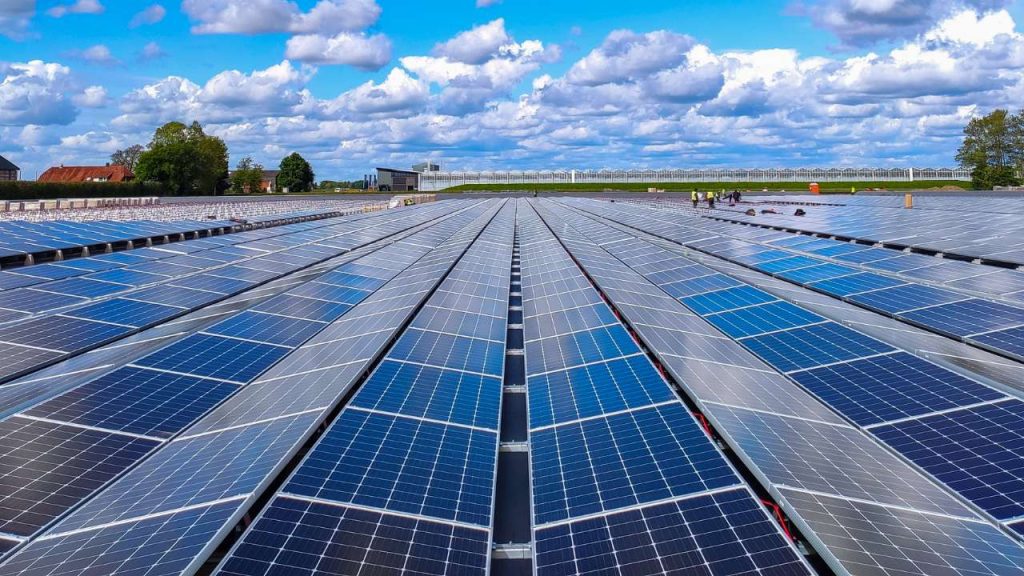
Most Irish businesses pay €1,000 to €1,500 per kWp for a turnkey rooftop system of 20kWp to 100kWp, excluding VAT and before any grant. The rate per kWp falls as systems get bigger, dropping to roughly €850 to €1,050 per kWp at 200kWp to 500kWp.
The rate falls with size because a large share of every job is fixed or semi-fixed. Design, the ESB Networks application, access equipment, commissioning and certification cost much the same whether the roof carries 50 panels or 500.
A like-for-like commercial quote should cover these items:
- Panels, inverters and the mounting system
- DC and AC cabling, isolators and protection
- Connection into your distribution board or switchgear
- The ESB Networks application for your connection type
- Access equipment, commissioning, certification and monitoring setup
If one quote looks much cheaper than another, check which of these lines is missing before comparing the totals.
Commercial Solar Cost in 2027 by System Size in Ireland
The table below shows indicative installed costs by system size, excluding VAT and before the grant. Rooftop systems from 20kWp to 500kWp range from about €22,000 to €525,000, while megawatt-scale projects are priced per site because grid connection and land costs dominate.
| System size | Typical fit | Cost per kWp (ex VAT) | Installed cost (ex VAT, before grant) |
| 20kWp | Small office, shop, workshop | €1,100 to €1,500 | €22,000 to €30,000 |
| 50kWp | Warehouse, small factory, hotel | €1,000 to €1,500 | €50,000 to €75,000 |
| 100kWp | Large factory or distribution unit | €1,000 to €1,500 | €100,000 to €150,000 |
| 200kWp | Multi-unit industrial site | €850 to €1,050 | €170,000 to €210,000 |
| 500kWp | Large industrial roof | €850 to €1,050 | €425,000 to €525,000 |
| 1MWp | Very large roof or ground mount | Quoted per project | Quoted per project |
| 5MW | Ground-mounted power plant | Quoted per project | Quoted per project |
| Utility scale | Solar farm exporting to the grid | Quoted per project | Quoted per project |
What Drives Commercial Solar Installation Costs in Ireland?
Roof type, grid connection and site access move a commercial solar price more than the panels themselves.
Two buildings asking for the same 100kWp system can get quotes tens of thousands of euro apart once the mounting system, the ESB Networks process and the electrical upgrades are priced in.
Roof Type and Mounting Costs for Commercial Solar
The mounting system is set by your roof, and each type carries a different labour and material cost. Our commercial solar panel installations use Schletter systems matched to the roof:
- Flat roofs take a non-penetrative ballasted frame, which needs a structural check that the roof can carry the extra load.
- Metal deck roofs on industrial units and sheds use high-load rail systems fixed to the sheeting.
- Standing seam roofs use clamps on the seams, with no drilling through the roof.
- Ground mounts add frames, foundations, trenching and often planning, which is why they sit at the project-priced end of the table.
Where ballast isn’t suitable, a penetrative flat-roof fixing is the fallback. An engineering-led design settles this at survey stage so it doesn’t turn into a variation halfway through the job.
Grid Connection Costs for Commercial Solar in Ireland
Your ESB Networks route depends on inverter capacity. Above 11kVA on a three-phase supply, the process stops being free and simple.
| ESB Networks category | Three-phase capacity | What it involves |
| Micro-generation (NC6) | Up to about 11kVA | Inform and fit, no connection charge |
| Mini-generation (NC7) | About 11kVA to 50kVA | Technical assessment, application fee and a connection offer |
| Small-scale generation | Above 50kVA up to 200kVA | Fuller application and assessment |
| Larger generation | Above 200kVA | Project-specific connection process |
For mini-generation, ESB Networks says not to install until you’ve signed and returned the connection agreement. Build that wait into the programme, because it sits between the grant offer and the start of works.
Other Factors That Move a Commercial Solar Quote
A handful of site details account for most of the remaining difference between quotes:
- Three-phase capacity. If the supply or distribution board can’t take the new generation, upgrades go on the bill.
- Access and safety. Edge protection, scaffolding or lifts, and working-at-height controls all scale with roof height and layout.
- Battery storage. There is no commercial battery grant, so any battery is paid for in full by the business.
- Monitoring. Inverter monitoring is standard, while metering at sub-board level adds cost but shows where the energy goes.
How the Non-Domestic Microgen Grant Cuts Commercial Solar Costs

For applications made up to 6 July 2027, the Non-Domestic Microgen Grant pays the lower of SEAI’s size-based value for your system or 45% of eligible ex-VAT costs, up to €325,200.
It covers solar PV systems up to 1MWp on businesses, farms, schools, clubs and other non-domestic buildings.
The grant has firm conditions that affect timing:
- SEAI approval must be in place before you buy materials or start works.
- The letter of offer is valid for eight months, so the install has to fit that window.
- You must use a company on SEAI’s Non-Domestic Microgen register.
- More than €10,000 in government grants in one calendar year requires a Tax Clearance Certificate.
- Batteries get no grant support under the scheme.
TAMS 3 can’t be combined with this grant on the same installation. Because the 45% figure is a ceiling, the real grant on a cheaper or larger system can come in lower. Our guide to the commercial solar grant explains eligibility and the application steps in more detail.
Illustration only. Take a 50kWp system quoted at €55,000 ex VAT, and assume 45% is the lower of the two SEAI figures for that system.
| Item | Amount |
| Installed cost (ex VAT) | €55,000 |
| Non-Domestic Microgen Grant at 45% | €24,750 |
| Net cost before tax relief | €30,250 |
Your installer confirms the actual grant at quote stage. SEAI’s official commercial solar PV grant page is where the application is made, and full grant administration can be handled on your behalf so the paperwork doesn’t hold up the project.
Tax Relief and VAT on Commercial Solar Panels in Ireland
A trading business can usually write off qualifying solar equipment against profits in the first year under the Accelerated Capital Allowance. VAT is charged on commercial installs, because the 0% solar rate is limited to private dwellings.
Whether that VAT is a cost or recoverable depends on your VAT position.
Accelerated Capital Allowance on Commercial Solar
The Accelerated Capital Allowance gives a 100% first-year allowance on new energy-efficient equipment listed on SEAI’s Triple E register. Without it, plant and machinery is written off at 12.5% a year over eight years.
Revenue’s guidance reflects the scheme’s extension to 31 December 2030. It applies to companies and, since 2017, to unincorporated businesses as well. The allowance is claimed on what you actually spend, so expect it to apply to the cost after the grant.
Check each panel and inverter model on the Triple E register before you place the order. Our explainer on the accelerated capital allowance for solar walks through the claim step by step, and your accountant confirms how it fits your accounts.
VAT on Commercial Solar Installations in Ireland
The 0% VAT rate on solar applies only to private dwellings. Revenue lists commercial, industrial, retail and farm buildings, hotels and B&Bs among the buildings it doesn’t cover.
On a commercial supply-and-install contract, Revenue’s guidance on VAT for solar panels says the reduced rate may apply, subject to the two-thirds rule. If the goods exceed two-thirds of the contract value, the standard rate applies to the whole contract. Supply-only panels are charged at the standard rate.
A VAT-registered business making taxable supplies can normally reclaim that VAT through its returns. Clubs, charities and businesses with VAT-exempt activity may only recover part of it, or none, so confirm your position before budgeting on an ex-VAT figure.
Commercial Solar Payback and Return in Ireland
As a typical estimate, commercial solar in Ireland pays back in about 4 to 7 years, with annual returns of around 14% to 25%.
Those ranges were set before the grant rose to 45%, and the real figure for your site depends mostly on how much of the electricity you use during the day.
| System size | Typical annual savings (estimate) |
| 20kWp | About €6,000 |
| 50kWp | About €12,000 |
These savings are estimates that depend on usage and tariff, and they aren’t guaranteed. The higher grant lowers the net cost, which improves payback, but the size of that gain depends on your quote and how the grant is calculated for your system.
Four things decide where your business lands in that range:
- Daytime self-consumption. Every unit you use on site saves your full import rate, while exported units earn less.
- Your unit rate. A higher day rate makes each solar unit worth more.
- Operating pattern. Weekday-only sites export more at weekends than seven-day operations.
- Net cost. Grant and tax relief reduce the sum you’re paying back.
Getting a Commercial Solar Quote Built on Real Usage Data
The most accurate commercial solar price starts with your half-hourly consumption data and a survey of the roof.
With both in hand, a system can be sized to your daytime load, the mounting matched to the roof structure, and the grant and ESB Networks applications lined up before the offer window starts running.
We’ve designed and installed hundreds of commercial systems as an SEAI-registered, ISO 9001 certified installer. To get a costed design for your building, request a commercial solar quote and we’ll come back with sizing, grant figures and an estimated payback for your site.