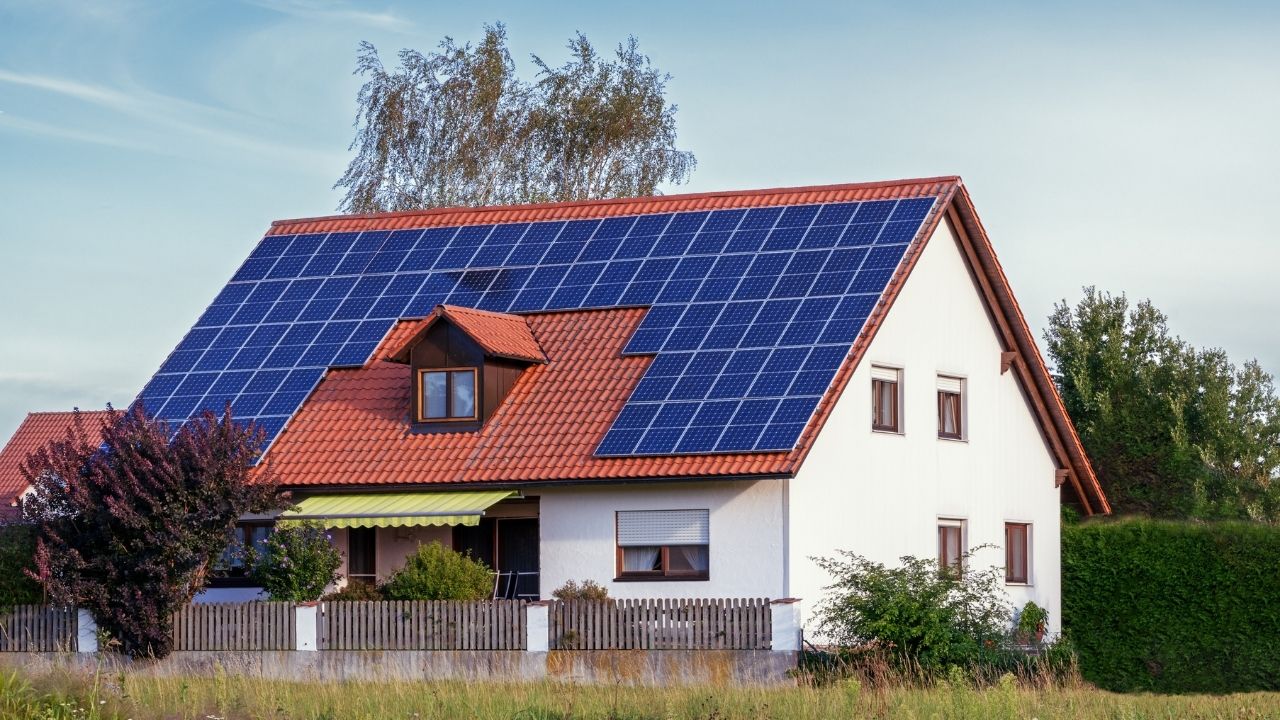
Solar power can cover a large share of an Irish home’s electricity, and across a full year a well-sized system can generate roughly as much as an average household consumes. Running a home entirely on the sun, every hour of every day with the grid switched off, is a very different and far more expensive undertaking.
So the honest answer is both yes and no, and knowing the difference matters before you invest. This guide explains what running a home on solar really involves in Ireland, how output changes from summer to winter, and where a battery fits in, giving you a clear and realistic picture for your own property.

What Running a House on Solar Really Means
People mean two different things by this question, and they lead to very different answers.
One meaning is covering your yearly electricity use with solar while staying connected to the grid. Your panels feed the house during the day, surplus goes to the grid, and you draw from the grid at night or when generation is low. Over twelve months your solar can match or beat what you consume.
Other meaning is true off-grid living, where your home is disconnected from the grid entirely and relies only on panels and batteries. This is possible, but it demands a much larger system, a big battery bank, and usually a backup generator for the darkest weeks.
Most Irish homeowners who ask this question actually want the first version. It gives you most of the benefit for a fraction of the cost.
How Much Electricity an Irish Home Uses
Before sizing anything, you need a target to aim at.
Average annual electricity use in an Irish household is about 4,200 kWh, the figure the Commission for Regulation of Utilities uses as the national benchmark. Smaller homes, such as a one or two bed apartment, might use closer to 3,000 kWh, while a large family home with electric heating, a tumble dryer, or an EV can pass 6,000 kWh.
Two details make Ireland tricky. Demand is highest in the evening, after the sun has dropped, and it is highest in winter, roughly a third above summer levels. Solar output does the opposite. That mismatch, not the yearly total, is the real design challenge.
What Solar Panels Actually Produce Here Across the Year
Here is where honesty pays off.
Panels in Ireland generate from daylight, not direct sun, so they still work on grey days. Modern systems produce roughly 850 to 950 kWh per year for every kWp installed. Take a typical 4 kWp array of around nine to thirteen panels. It produces about 3,600 to 4,000 kWh across a full year, which on paper is close to the average home’s usage.
Season is where the gap opens up. That same 4 kWp system might produce 80 to 120 kWh in December, then 420 to 650 kWh in June. Winter months from November to February deliver only around 10 to 20 per cent of the annual total, even though they make up a third of the year. On a dark December day you might collect 2 to 4 kWh while the house is using 12 or more.
You cannot store July sunshine for January, and that single fact shapes every sensible decision about running a home on solar in Ireland.

Grid-Tied Solar With a Battery: What Most Homes Need
For nearly every home in Ireland, this is the setup that makes sense.
Grid-tied means your solar system works alongside the national grid. When the sun is out, you use your own power first and send any surplus to the grid. When your panels are not keeping up, in the evening, overnight, or in winter, you draw from the grid as normal. You are never left in the dark, and you avoid paying for a huge battery bank you would only need a few weeks a year.
Adding a battery lifts this further. Without storage, a typical home uses only about 30 to 40 per cent of what its panels generate, exporting the rest. Home batteries capture the midday surplus for use in the evening, pushing self-consumption up to around 60 to 85 per cent. That matters because a unit you use yourself is worth far more than a unit you export. Import prices sit around 35 cent per kWh, while export payments are closer to 18 to 20 cent.
Panels do not generate at night, so evening and overnight power comes from your battery or the grid. With the right battery, a grid-tied home can run on stored solar well into the night for much of the year.
Going Completely Off-Grid: Possible, Rarely Practical
Cutting the cord entirely is where the maths turns against you.
To survive an Irish winter with no grid, you would need to oversize your panels heavily, install a very large battery bank to cover days of poor generation, and most likely keep a backup generator for prolonged dull spells. Because December output can be a tenth of summer output, sizing for the worst weeks means paying for capacity that sits idle for most of the year.
For a remote property with no grid connection, or a very high connection cost, off-grid can be the right call. For a normal home already on the grid, it rarely stacks up once you understand the difference between grid-tied and off-grid systems. Staying grid-tied lets the grid act as your winter backup at no extra hardware cost, which is far cheaper than batteries sized for January.
What Size System and Battery You Would Need
Sizing is always specific to your roof and your habits, but rough guides help.
To cover most of an average home’s yearly use, a system of around 4 to 6 kWp is a common starting point, which is roughly nine to sixteen panels depending on their wattage. South-facing roofs at a pitch of about thirty to forty degrees perform best, though east and west roofs still work well.
Battery size depends on your evening usage. Many Irish homes land on a 5 to 10 kWh battery, enough to shift a good share of daytime solar into the evening. Bigger is not automatically better, since a battery you never fully use is money tied up for little return. Homes with an EV or a heat pump can justify larger storage.
Rather than guess, it is worth running your own numbers. Going Solar’s online solar calculator gives a quick estimate of system size and savings based on your home, and a site survey confirms the detail.

Costs, Grants and Getting Paid for Export
Here is what the numbers look like in 2026.
Residential solar attracts 0 per cent VAT in Ireland, which keeps the upfront cost down. On top of that, the SEAI solar grant pays 700 euro per kWp for the first 2 kWp and 200 euro per kWp for the next 2 kWp, up to a maximum of 1,800 euro for a system of 4 kWp or more. Homes built and occupied before 2021 qualify, and the installer must be SEAI registered.
Adding a battery is a separate cost. Home battery storage in Ireland typically runs from about 4,000 to 8,000 euro installed for a 5 to 10 kWh unit. Grant support covers the panels rather than the battery, and batteries attract 0 per cent VAT when fitted with solar.
Export income helps too. Under the Clean Export Guarantee, your supplier pays you for surplus electricity sent to the grid. Standard rates in 2026 sit around 18 to 20 cent per kWh depending on the supplier, and the first 400 euro of export income each year is tax free. Rates change and vary between suppliers, so it is worth checking current offers.
Every home is different, so treat these as guide figures. Going Solar confirms the exact numbers for your property after a survey and handles the grant paperwork on your behalf.
How to Get the Most From Solar in an Irish Home
Some habits stretch the value of any system.
Improve efficiency first. Better insulation and efficient appliances mean a smaller, cheaper system covers more of your needs.
Shift heavy use to daylight. Run the dishwasher, washing machine, or EV charging while the sun is up so you use your own power.
Keep panels clear. Occasional cleaning and removing shade from trees or aerials protects output.
Mind orientation and pitch. South-facing at thirty to forty degrees is ideal, though most roofs still perform.
Match a battery to your evenings, not to a spec sheet. Size it around what you actually use after dark.
Talk to Going Solar About Your Home
Whether you want to cover most of your bills or explore going off-grid, the right answer starts with your roof, your usage, and a proper survey. Going Solar designs and installs SEAI-approved systems across Dublin and Leinster, handles the grant paperwork, and sizes your panels and battery to how you actually live.
Ready to see what your home could do on solar? Call Going Solar on (01) 485 3738 or request a free consultation and quote.